Category Archives: Awards

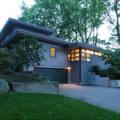
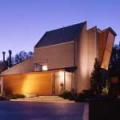
Clarendon Residence

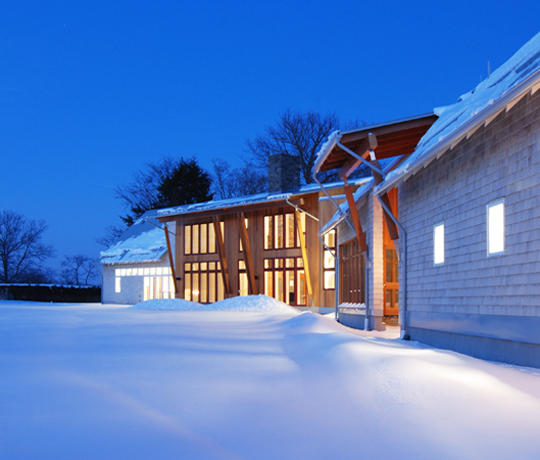
Sited on Providence’s East Side, this project takes cues from the original contemporary architecture to craft an addition that captures airy and open living space that retains a strong sense privacy. A careful hand with proportion, detailing and material selection are key components in the success of the project.

Smith-Buonanno Hall, Brown University

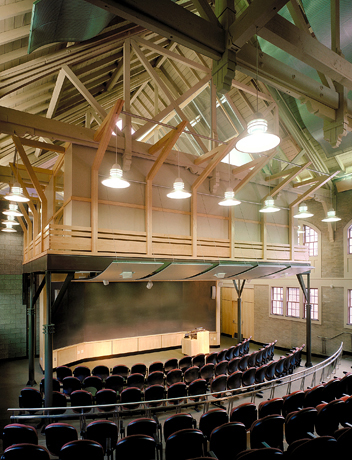
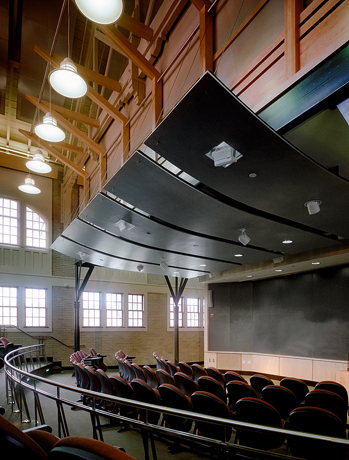
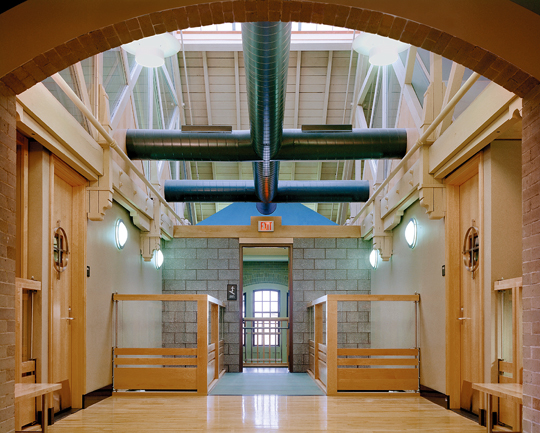
Renovation of the historically and architecturally significant 1907 Sayles gymnasium at Brown University combined meticulous restoration of the unaltered Tudor Revival exterior and judicious rehabilitation of the interior. The program’s six state-of-the-art classrooms of varying sizes and didactic uses required reconfiguration of the large gymnasium space on the upper level.

By using that volume for the large lecture hall and tucking smaller classrooms above it within the exposed trusses, KITE both respected the space and took inspiration from its utilitarian architectural vocabulary. This project sets an enviable standard for historic rehabilitation by handsomely proclaiming what the building was as well as what it now is.

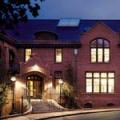
College Hill Residence

KITE’s work at this historic house on Providence’s College Hill included an exterior restoration of the main house, complete renovation of the interiors, and a carefully detailed significant addition. Expanded and reorganized interiors and new outdoor spaces feature breathtaking views of the Providence skyline.

The project was subject to stringent review by the Providence Historic District Commission, and the completed home was featured in Providence Preservation Society’s Festival of Historic Houses. The careful integration of the addition and sensitive interior modifications illustrate how a historic home can be added to and modified to include spacious open-plan living areas without sacrificing the original character of the house.

Photographs by Neil Alexander

Alger Hall, School of Management, Rhode Island College

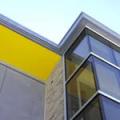
Alger Hall, a circa 1960’s modern building, is centrally located on the Rhode Island College campus and was identified by the college as an ideal location for the growing School of Management and Technology. KITE started with a simple recladding of the existing 1950’s structure and ended up transforming the use and image of the building inside and out with a pair of bold additions and reorganization of the interior.

KITE designed additions on the east and west ends of the building that engage significant places along the central campus road and student walkway. To the east, a large flexible community space is created for departmental assembly functions as well as larger campus-wide events. The west addition utilizes advanced glass coatings to control solar heat gain and provide visual privacy to the student and faculty lounges within.

An innovative, prefabricated GFRC (glass fiber reinforced concrete) wall system was developed in collaboration with industry leaders to suit the specific cost, schedule, and aesthetic concerns, while satisfying the structural and thermal performance requirements.

“Two years of careful design work has resulted in one of the finest teaching facilities in New England, certainly for the teaching of business and economics. Rhode Islanders will be proud to know the level of this facility and what RIC is doing to help prepare the workforce leaders of Rhode Island.” – James Schweikert, Dean of the School of Management and Technology

Saint James Episcopal Church

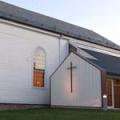
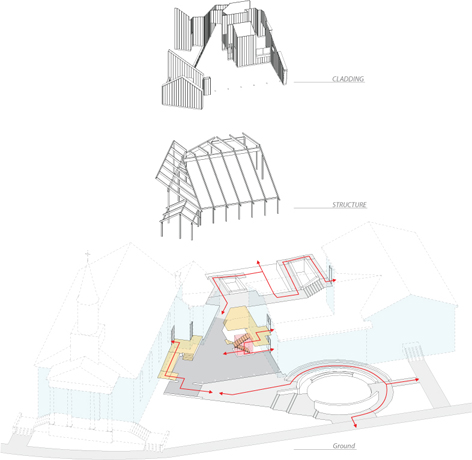
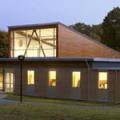
At its heart, KITE’s design for a new connector structure at Saint James Episcopal Church is intended to project the energy and vitality of the parish to the surrounding community.

Established in 1832, Saint James Episcopal Church is the first church built in Woonsocket, RI.  The original Victorian style structure underwent major alterations in the 1930s to conform to a Colonial style of architectum and in the 1960s, a Parish Building was added onto the existing Church. For years, the Parish struggled with accessibility, circulation, and safety issues that KITE’s new structure solves.

The most dramatic feature in the central gathering area is a skylight that runs the length of the space and washes the wall of the historic church in light, making the exterior architecture an interior focus.

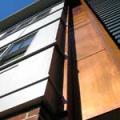
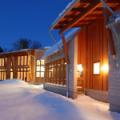
A fully glazed south wall opens out onto a new south terrace.  A series of carefully considered landscape design elements on both sides of the buildings create enhanced entrances and gardens. The design focuses on a simple and refined palette of materials and construction details that maximize the potential of a limited budget.  Materials such as white-washed board and battens and copper accents bring rich texture to the project.

School of Social Work, Rhode Island College

School of Social Work is an expanding presence at Rhode Island College that has grown to offer Bachelor and Master of Social Work degrees to over 375 students. Formerly occupied by the Rhode Island Department of Children, Youth, and Families, “Building No. 9” was chosen as the new home for the School and its associates Institutes.

The existing building included a derelict central exterior courtyard and a partial basement, providing approximately 24,000 square feet of enclosed space. KITE chose to work entirely within the existing building, utilizing existing partitions wherever possible to conserve construction funds in a constrained budget.

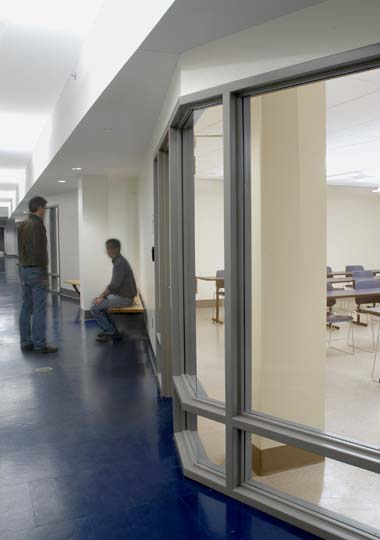
The defining feature of the Project is the central lobby, created by enclosing the existing courtyard with a new glazed shed roof. This “found space” provides gathering place for faculty and students that fosters a sense of community and encourages spontaneous socializing and unprogrammed learning opportunities. New “smart” technology classrooms and computer labs augment 34 faculty offices and dean’s suite.

Bristol Residence

Built on a gently sloping site with views to Bristol Harbor to the East and Narragansett Bay to the West, this home maximizes its setting by taking advantage of the multitude of dramatic views available.  By creating a singular width, linear composition of rooms, views in both directions are provided from all spaces.  The structural transparency provides unique places to enjoy views through changing light patterns occurring throughout the day and seasons of the year.  During the design phase, views were carefully studied and recorded and were used as the basis for the layout of the interior spaces.

The architectural building forms recall the traditional shingled cottages that dot the New England shore while making their own statement of style, special to its programmed use.  It is neither traditional nor modern, but unique to its location.

Its interior design uses natural stone in a nod to the stone walls that run across the site dating to its history as agricultural land.  Exposed wood is carefully placed to accent the crisp painted cedar siding. Inside, a feeling of lightness appropriate to a seaside retreat is extended to the ample spaces for large family gatherings and the professional grade kitchen.

Several features are designed with an eye toward sustainability, including the use of a geothermal well for heating and cooling which is projected to pay for itself in only three years, use of locally harvested certified wood flooring throughout which will also aid indoor air quality, and capture of rainwater for irrigation.

Crossroads RI

Crossroads RI, a rapidly growing social service agency, acquired a large underutilized downtown YMCA and challenged KITE to re-identify this dilapidated landmark structure and treat the clientele with the architectural respect and dignity that will lead them back to self-sufficiency and ultimately contributing membership in the community.

Previous significant alterations to exterior features and interior spaces increased the potential both to create a new image for the building and to accommodate an ambitious program. Newly created spaces provide education, counseling, and health services for clients, office and support space for staff and volunteers, and rental apartments for disadvantaged persons. The high-intensity program required rigorous differentiation of space for the safety of clients and staff, a cheerful atmosphere for easing stressful situations, durable materials for heavy use and ease of maintenance, and adherence to a modest budget.

KITE’s design orchestrates the space into rational and accessible, yet separated areas that allow families, adolescents, and adults to receive program-specific services without potentially dangerous overlaps or unnecessary feeling of compartmentalization. Color and material are employed to de-emphasize those spaces’ institutional qualities.

Offices of KITE Architects, Rising Sun Mills

This 3,500 square foot, free-standing building with street frontage offered everything that KITE could have asked for – open studio space, large windows, and high ceilings. In order to emphasize the collaborative nature of the working process, spaces are kept open. In fact, less than 10% of the space is enclosed for toilet rooms, storage, and private conferences. The remaining space has been cleverly articulated by the controlled placement of two folding wall planes that wind around the studio and free-standing millwork work stations.

Carefully crafting the interiors as a total environment, the architects at KITE designed their own custom-built furniture, including workstations, library shelving, reception desk, work tables, and conference tables. The result is a showcase that exemplifies KITE’s unique sense of space, material, light, and attention to detail.

As an example of how sustainable design is integrated into KITE’s approach, the office features copious but balanced daylight, mechanical systems that maximize outside air use, and environmentally responsible finishes such as worktop surfaces made from Marmoleum (made from linseed oil) and recycled MDF furniture surfaces. KITE’s commitment to building strong and diverse urban neighborhoods that reuse existing buildings and infrastructure and are both pedestrian and transit friendly is demonstrated by the choice to locate in the historic mill district of Olneyville.

Lincoln Residence II

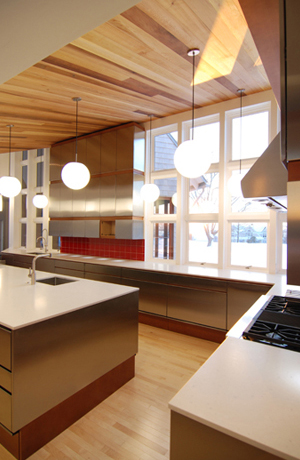
Set within a cul-de-sac development and bounded by large, mixed quality two-story houses, agricultural land, and a mature deciduous woods, the challenge was to produce a home of minimal maintenance construction, abundant natural light, openness between spaces and exacting precision with all aspects of the construction. The design strives to capture the Owner’s passion for modern architecture and contemporary design.

The plan has been distilled to contain discrete spaces for parents and children that effortlessly reconnect for shared activities while maintaining a high degree of privacy from the street. Traditional New England forms and materials – shed roofs, masonry, copper, and wood siding – are juxtaposed with terrazzo, stainless steel, and glass, to a powerfully contemporary effect and proudly left in their natural state.

A very close working relationship was developed with the craftsmen executing the work. The outcome is a serene, highly contained and introspective design that carefully focuses on the needs of the family that dwells within, while stimulating the observer.